
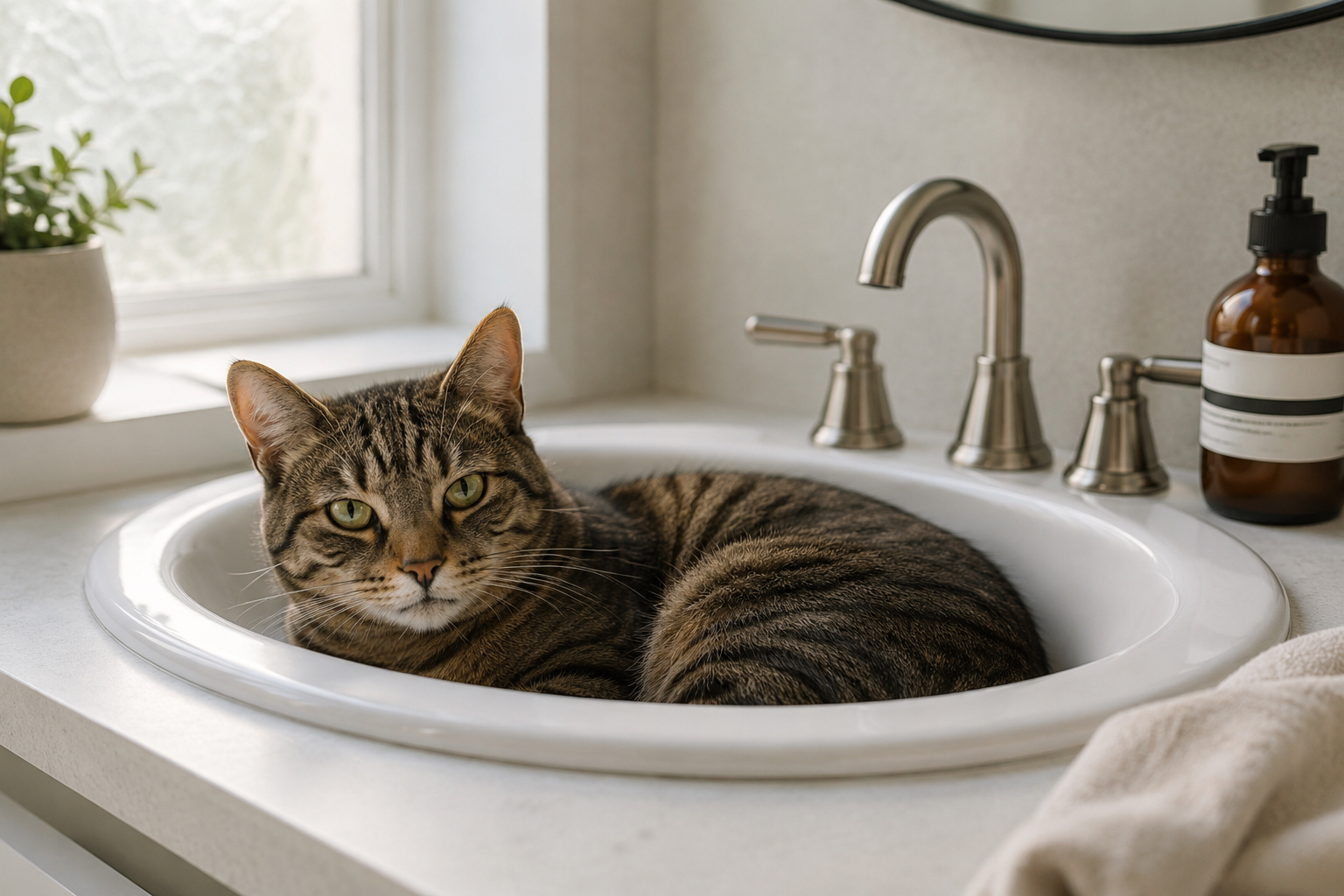
If your cat treats the bathroom sink like a throne, a bed, and a private drinking fountain, the behavior is probably not random. A sink is elevated, slightly enclosed, often cool to the touch, and usually located in a quieter part of the house. For some cats it also becomes associated with running water, owner attention, or predictable daily routines.
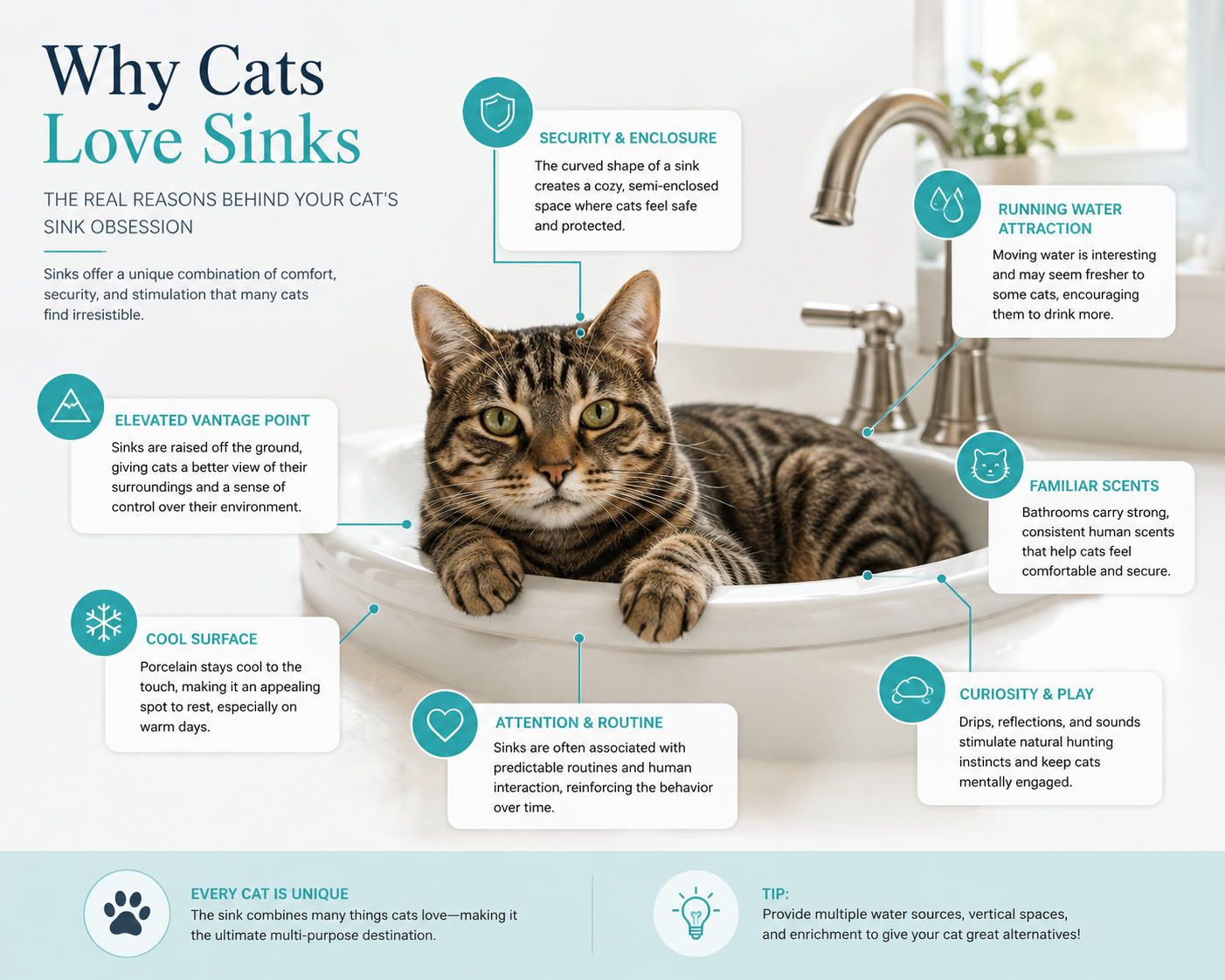
The important thing to understand is that sink obsession is usually multifactorial. Most cats aren't drawn to sinks for one single reason — the same themes tend to repeat: security, comfort, curiosity, hydration habits, and learned routines.
In most households, sink behavior is harmless and simply reflects a cat finding a space that feels safe and rewarding. But sudden or extreme sink obsession can occasionally point toward a medical issue, especially if it appears alongside increased thirst, urinary changes, vomiting, weight loss, or lethargy.
Why sinks appeal to cats
One of the strongest explanations is environmental comfort. Cats naturally prefer spaces that feel elevated, secure, and predictable. A sink happens to combine all three.
The curved shape of a sink supports the cat's body in a way many cats seem to enjoy. The basin creates a semi-enclosed resting spot that feels protected without being completely hidden. Compared to an open floor, the sink gives the cat a better vantage point to monitor the room while still feeling tucked away.
Bathroom sinks also tend to exist in quieter, lower-traffic areas of the home. That matters more than many owners realize — cats generally prefer environments where they can observe activity without constantly being disturbed.
Many sink-focused cats aren't even exclusively interested in water. Some primarily nap in the sink and only occasionally interact with the faucet. That pattern supports the idea that the sink itself functions as a preferred resting environment rather than simply a water source.
Many cats dislike having food, water, litter boxes, and sleeping areas crowded together. A sink is a physically separate location that may simply feel calmer and cleaner.
Do cats really prefer running water?
This is one of the most repeated claims online — but the research is more nuanced than many articles suggest.
Some cats absolutely seem fascinated by running water. They may paw at dripping faucets, wait beside the sink for someone to turn the tap on, or ignore standing bowls completely. For those cats, moving water appears more interesting or engaging.
However, evidence does not support the idea that all cats universally prefer running water. Several controlled studies found that many cats showed little overall preference between still water, circulating fountain water, or free-falling water systems.
That said, individual variation matters a lot. A cat may prefer wide bowls, shallow dishes, ceramic materials, elevated water stations, or water placed far away from food. This is one reason cat water fountains produce mixed results in real homes — some cats adapt immediately, while others continue demanding faucet access despite having a high-quality fountain nearby.
For more on this, see our deep-dive into why cats prefer running water and the fountains that actually convert picky drinkers in our 2026 cat fountain rankings.
The cool surface theory
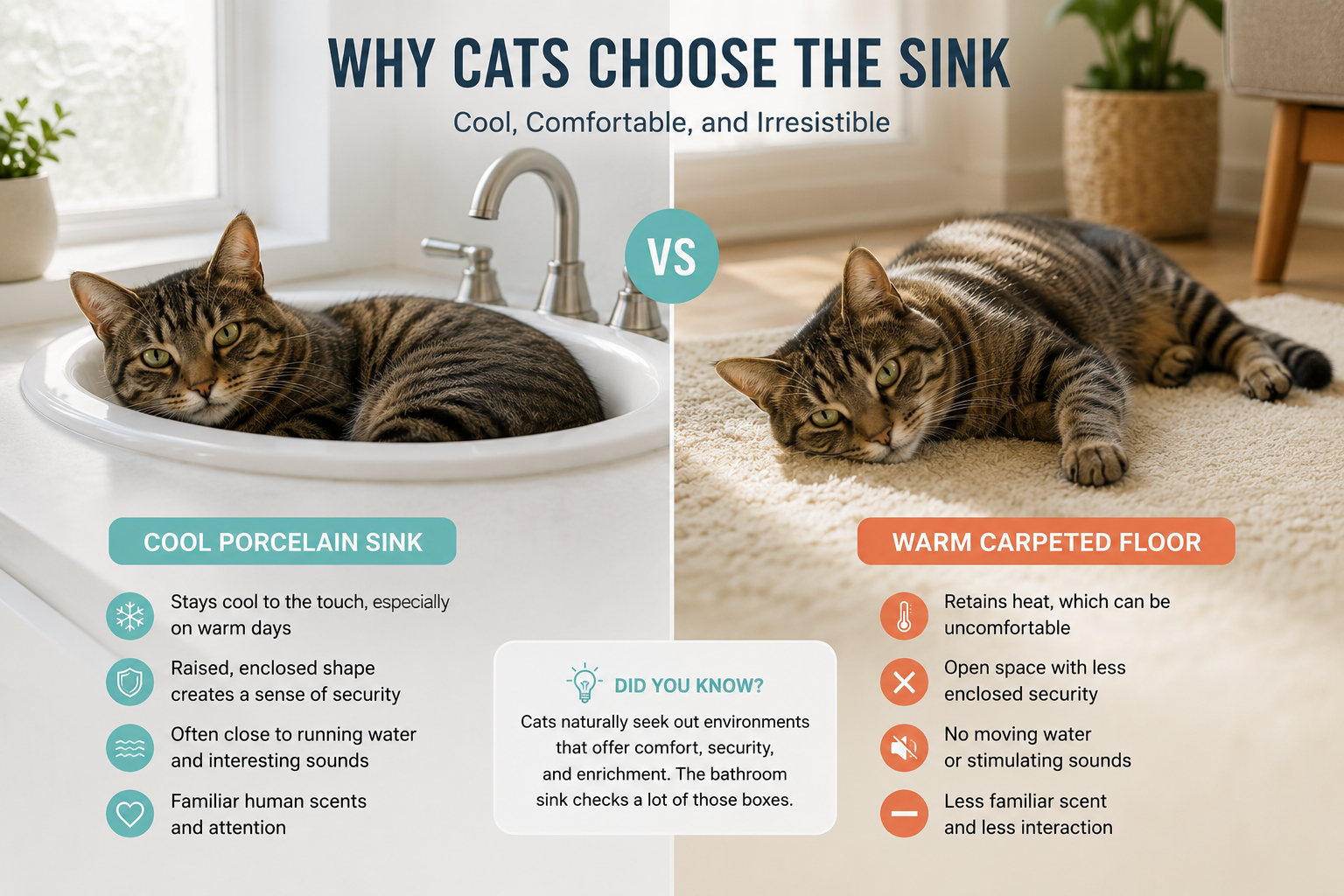
Porcelain and ceramic sinks often stay noticeably cooler than surrounding surfaces, especially during warmer months. Cats already tend to seek out temperature-controlled resting areas throughout the house — tile floors, bathtubs, shaded countertops, and cool laundry rooms.
A sink provides a naturally cool surface combined with body-contouring support. That combination can become especially attractive during summer or in warmer indoor environments.
It's important not to overstate this explanation — direct research specifically proving cats choose sinks primarily for cooling is limited. The theory is biologically plausible and strongly supported by owner observation, but it's probably just one piece of the larger behavioral puzzle.
If your cat seems especially drawn to the sink during warm weather, adding a cooling mat or providing additional cool resting surfaces nearby may reduce some of the sink fixation.
Curiosity, dripping faucets, and play behavior
Some sink-loving cats are less interested in comfort and more interested in stimulation. Dripping faucets create movement, sound, reflections, and unpredictability — all features that naturally trigger feline curiosity. To a cat, a slow drip can resemble prey-like motion patterns that activate hunting instincts and exploratory behavior.
Common sink-play behaviors
- Pawing at droplets
- Watching water swirl down the drain
- Waiting for faucets to drip
- Jumping into the sink when someone enters the bathroom
- Batting at reflected light patterns in water
These behaviors are often rooted in play and sensory engagement rather than thirst alone. Younger and more active cats tend to display more interactive sink behavior, while older cats often just lounge in the basin.
Increasing daily enrichment can sometimes reduce sink obsession noticeably. Interactive wand toys, puzzle feeders, climbing structures, and scheduled play sessions often redirect some of that curiosity elsewhere.
Your cat may have learned that the sink 'works'
This is one of the most relatable explanations because owners often reinforce sink behavior without realizing it. If your cat jumps into the sink and you immediately:
Cats are excellent at repeating behaviors that reliably produce results. Over time, the sink becomes part of a predictable social routine. A cat jumps into the sink while someone brushes their teeth. The owner responds. The cat repeats the behavior tomorrow.
This is especially common in households where the bathroom is one of the few places where humans remain stationary and accessible for several uninterrupted minutes. In some cases, the cat may care less about the faucet itself and more about proximity to you.
Scent and familiarity matter too
Cats rely heavily on scent cues to evaluate comfort and safety. Bathrooms contain extremely consistent human scent patterns through grooming products, handwashing routines, towels, and repeated owner presence. Over time, the sink area becomes a highly familiar social location.
Cats also commonly rub facial scent glands on corners, counters, and sink edges. This creates additional scent familiarity that can strengthen attachment to the area.
Strong-smelling cleaning chemicals can sometimes disrupt this pattern. Some cats temporarily avoid sinks immediately after heavily fragranced cleaners are used, while others return once familiar scent cues rebuild. Using milder, pet-safe cleaners may help maintain comfort without encouraging unsanitary buildup.
When sink obsession could signal a medical problem
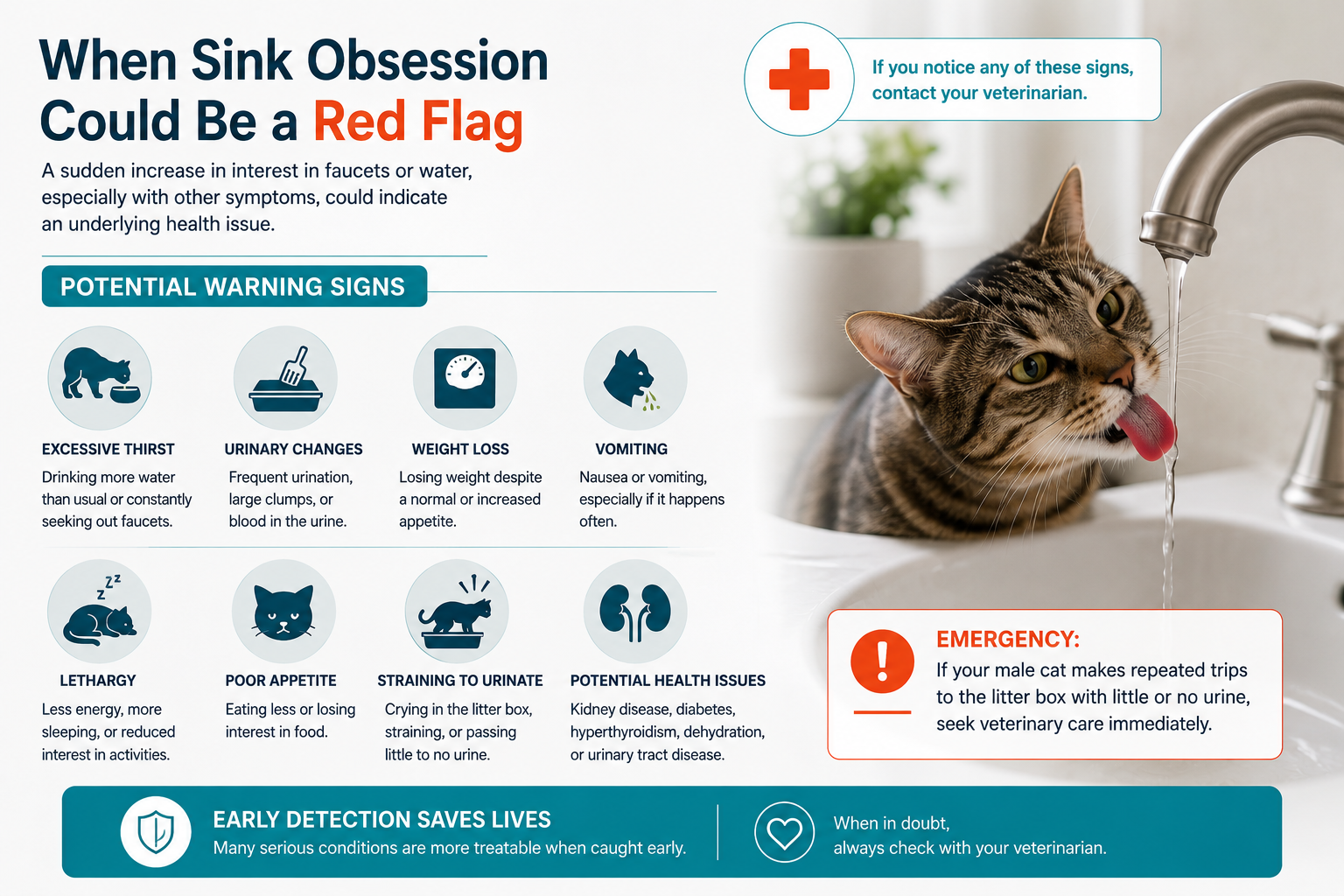
A cat that has always enjoyed sleeping in sinks is usually displaying a harmless personality quirk. But a sudden increase in sink-related behavior deserves closer attention.
Conditions sometimes linked to excessive thirst:
- Chronic kidney disease
- Diabetes mellitus
- Hyperthyroidism
- Dehydration
- Lower urinary tract disease
The behavior becomes more concerning when paired with additional symptoms like:
- Larger urine clumps
- Frequent urination
- Weight loss
- Vomiting
- Lethargy
- Crying in the litter box
- Urinary straining
- Reduced appetite
Emergency: repeated litter-box trips with little or no urine production — especially in male cats — can indicate a urinary obstruction. Seek veterinary care immediately.
A sudden behavioral change is usually more important than the sink obsession itself. If your cat suddenly becomes intensely focused on faucets after years of normal behavior, a veterinary visit is the safest next step.
What owners should do
The best response is environmental improvement rather than punishment.
For hydration support
- Provide multiple water stations around the home
- Keep water away from food bowls and litter boxes
- Test ceramic, stainless steel, or glass bowls
- Wash bowls daily to prevent biofilm
- Try a fountain as an experiment — not a guarantee
- Add wet food or extra water to meals when appropriate
For comfort and resting behavior
- Add a nearby perch or elevated bed
- Try a cooling mat during warm weather
- Create quiet resting areas away from foot traffic
- Leave carriers or covered beds open as safe resting spots
For attention-seeking behavior
- Reward alternative resting locations
- Increase structured playtime
- Avoid automatically turning on the faucet every time
- Build predictable interaction routines outside the bathroom
One of the biggest mistakes owners make is treating sink behavior as something that must immediately be "fixed." In many homes, the sink simply fulfills several environmental preferences at once. The goal isn't always elimination — it's understanding why the cat finds the sink rewarding and deciding whether the habit is harmless, inconvenient, or potentially medical.
Avoid this common mistake
Spraying or scolding a cat away from the sink rarely works and often damages the bond. Cats don't associate punishment with the behavior — they associate it with you.
Frequently asked questions
The questions cat owners ask us most about sink obsession, faucet-drinking, and when to worry.
Final thoughts
The most accurate answer to "Why is my cat obsessed with the sink?" isn't simply "because cats are weird." A sink combines several things cats naturally value — elevation, enclosure, cool surfaces, predictable routines, familiar scent, and sometimes access to moving water and owner attention. For many cats, it becomes an ideal multi-purpose environment.
In most cases, sink obsession is harmless and reflects a cat adapting creatively to its environment. But sudden changes in thirst, urination, or behavior should never be ignored. The smartest approach is observation rather than frustration — improve the environment, support healthy hydration habits, create appealing alternatives, and pay attention to behavioral changes that seem out of character.
Sometimes the sink is just a favorite spot. Sometimes it's useful information.
Want more? Read our companion guide on why cats prefer running water, browse our full FAQ, or jump back to The PetReview Journal.